An excavator track roller serves as one of the most important load-bearing components in the undercarriage assembly. During operation, the roller supports the machine’s weight, guides the track chain, absorbs impact from uneven terrain, and helps maintain smooth movement.
Because track rollers operate under constant pressure, their design directly affects the lifespan of other excavator undercarriage parts. Choosing the correct track roller can improve machine stability, reduce wear, and lower maintenance expenses.
As a critical category of excavator parts, track rollers require careful selection based on working conditions and equipment requirements.
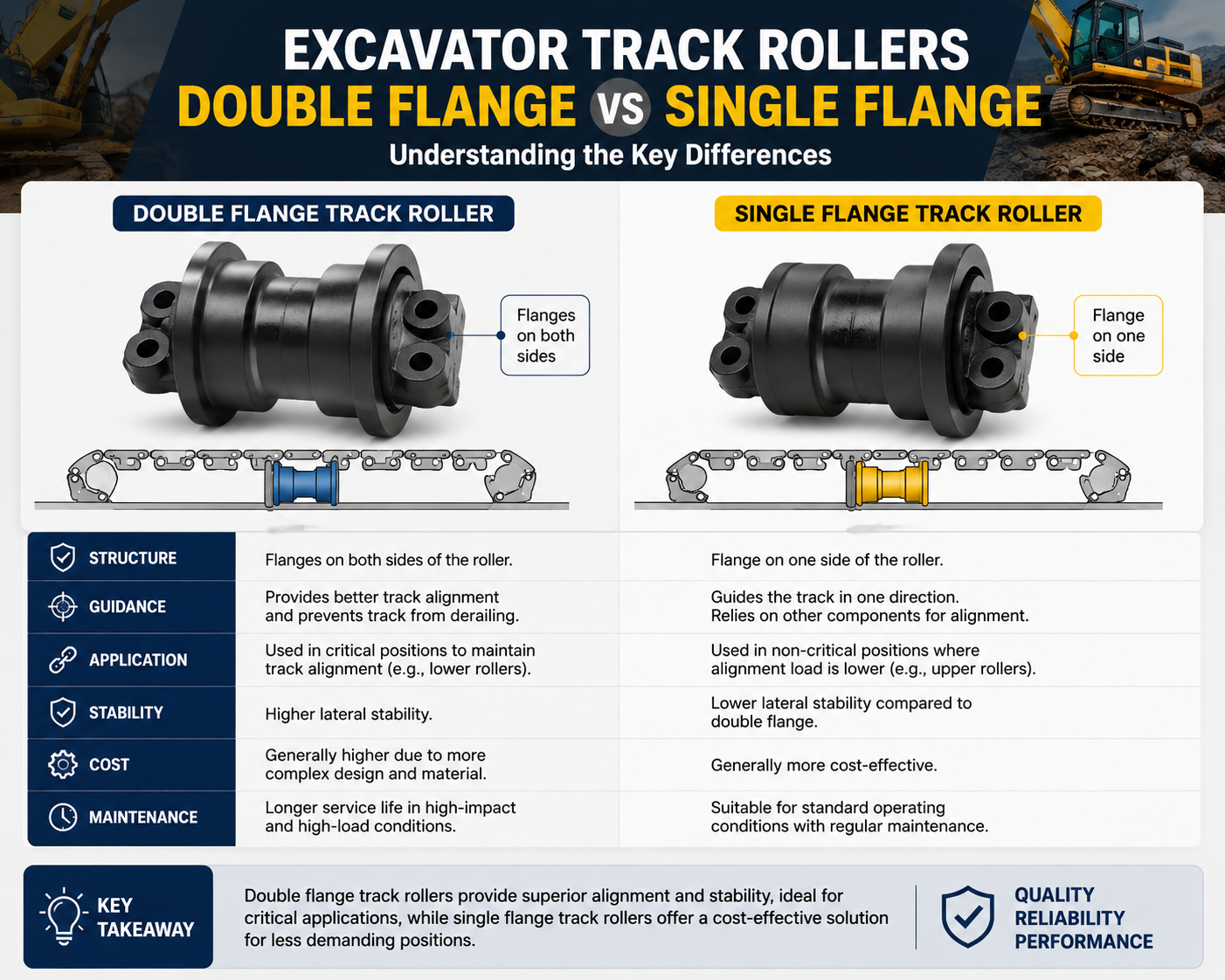
A single flange track roller features one guiding edge located on either side of the roller body. The flange helps keep the track chain aligned while allowing a certain amount of flexibility during movement.
Manufacturers often install single flange rollers in positions where the track naturally remains aligned and where excessive lateral force rarely occurs.
Many standard excavators rely on single flange excavator track roller designs because they offer an effective balance between performance and affordability.
A double flange track roller includes guiding flanges on both sides of the roller body. This design creates additional control over track movement and provides stronger guidance under difficult operating conditions.
Double flange rollers help prevent track deviation when excavators work on steep slopes, rocky terrain, or uneven surfaces.
For demanding applications, many contractors choose double flange excavator undercarriage parts to increase reliability and productivity.
The most obvious difference lies in the flange configuration.
A single flange track roller contains one guide flange, while a double flange roller contains two guide flanges positioned on opposite sides.
This additional flange increases track control and reduces lateral movement. As a result, double flange rollers often perform better when excavators encounter frequent directional changes or rough ground conditions.
Although both designs belong to the same family of excavator parts, their structural differences influence performance in different environments.
Track guidance represents one of the most important functions of an excavator track roller.
Single flange rollers provide adequate guidance during normal excavation work. They perform well on relatively flat surfaces and moderate-duty job sites.
Double flange rollers create stronger contact with the track chain and offer superior guidance. This design helps maintain proper track alignment even when machines operate under severe side loads.
When operators prioritize stability, double flange track roller solutions often deliver better results.
Durability depends on material quality, heat treatment, sealing systems, and operating conditions. However, flange design also influences component lifespan.
Double flange rollers distribute side forces more effectively and reduce stress concentration during operation. Because of this advantage, they often achieve longer service life in harsh environments.
Single flange rollers remain highly durable when matched with appropriate working conditions and quality manufacturing standards.
Selecting premium excavator undercarriage parts always plays a greater role than flange configuration alone.
Matching the correct excavator track roller to the application helps maximize machine efficiency and reduce maintenance costs.
Whether you select a single flange or double flange design, manufacturing quality remains essential.
Premium track roller products typically feature:
High-quality excavator parts deliver better wear resistance, improved reliability, and longer service intervals.
Both single flange and double flange rollers play important roles in modern undercarriage systems. A single flange excavator track roller offers excellent value for standard excavation work, while a double flange track roller provides enhanced guidance and stability in demanding environments.
When selecting excavator undercarriage parts, operators should consider terrain, workload, machine type, and operating conditions. Investing in high-quality excavator parts ensures longer service life, improved productivity, and lower operating costs throughout the equipment’s lifecycle.
Contact us via TEL / WhatsApp / WeChat Quick response within 12 hours

Production Experience

Export Experience

Quality Guaranteed

Fast & Reliable


 +86 1588 0208980

 doozer@doozergroup.com